
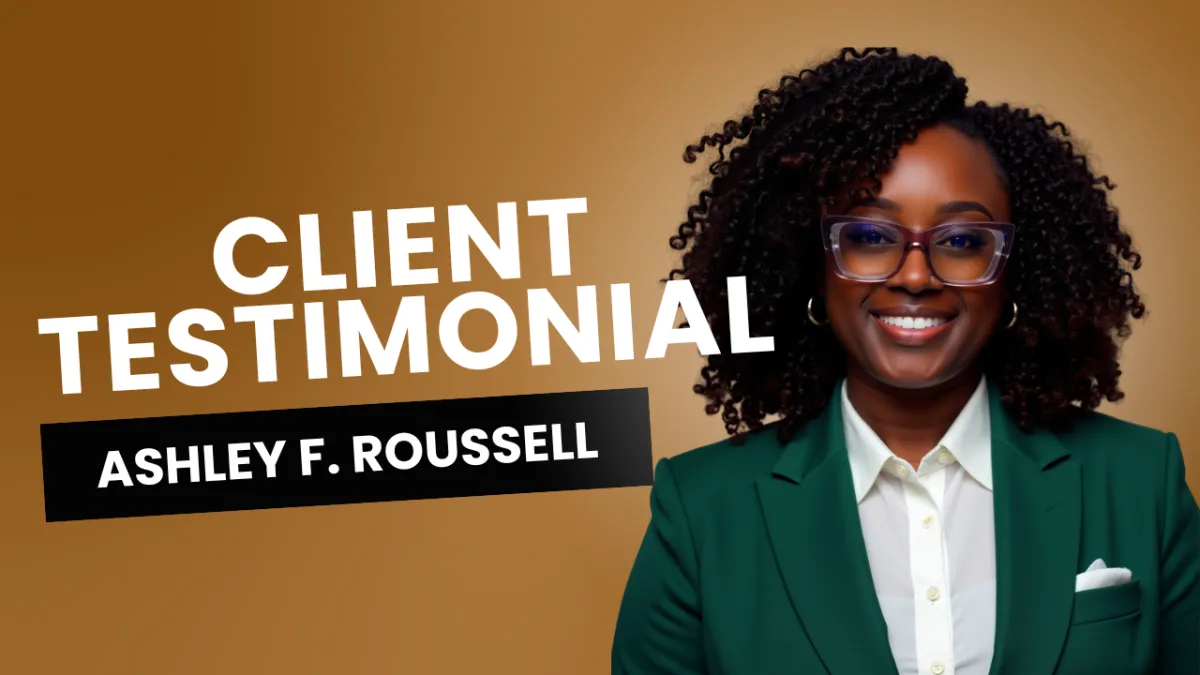
How Ashley Rousselle Got Her Clinic Out of Her Head: A Remote Catalyst Case Study
A Jacksonville primary care, mental health, and aesthetics clinic owner had built real revenue and a real team. She was still drowning in day-to-day tasks. Here is what we built together.
There is a quiet kind of exhaustion that does not show up on a P&L.
It is the founder who can give you the revenue number off the top of her head and cannot tell you who else has the password to the booking system. It is the founder whose team is asleep at 9pm while she answers messages from her phone, in her own kitchen, again. It is the founder who built something extraordinary and now lives inside it.
This case study is about one of those founders. Ashley Rousselle owns a primary care, mental health, and aesthetics clinic in Jacksonville, Florida. By every external measure, she had built the thing. Real team. Real revenue. Real waiting list.
Internally, she was the only person who knew where everything actually lived.
What follows is the story of what we worked on together, what we found in the first session, and the question that drove every decision after that.
Related Blog Post: What a Business Operations Consultant Actually Does, How to Hire, and What to Pay
Key Takeaways
📌 The operational ceiling shows up in the boring layer first: passwords, access, ownership of tools you are already paying for.
📌 You cannot build clean workflows on top of a messy access layer. The audit always starts with what you cannot easily hand off.
📌 The question that drives a real engagement is not "what should I delegate." It is "what happens to my business when I am not there."
📌 A real diagnostic ends with a detailed printout: what to build, what positions to hire, what tools to keep, what to retire.
📌 Implementation is a 30-day discipline on the founder's side. The consultant does not do it for her. The consultant builds the architecture and hands her the plan.
Meet the Hero
Ashley Rousselle runs a multi-service practice in Jacksonville: primary care, mental health, and aesthetics under one clinic. She has a team. She has a roster of clients. She has the kind of business profile that, from the outside, looks like she has figured it out.
In her own words from our first conversation: "I had the opportunity to work with The Remote Catalyst recently about just general operational things within my business. And let me tell you, it was one of the best experiences I ever had."
The reason she reached out was not that the clinic was failing. The reason was that the clinic was working, and she still could not step away from any of it.
The Problem Story
Ashley named the weight herself before we ever got into the work.
"I knew I was drowning in day-to-day tasks. I knew that I did not have my systems in place. But it was a matter of how to get these things done and what to do and how to transition."
Read that sentence twice. The diagnostic was already in her head. The execution was not. That is the operational ceiling for most seven-figure female founders. They know what is broken. They do not know how to step out of the work long enough to fix it.
The first thing I asked Ashley for was access. Not a strategy doc. Not a vision board. Access.
Here is what we found.
She could not easily give me access to the platforms her clinic was running on. Not because she was hiding anything. Because the access layer had never been organized. Tools she was paying for monthly. Tools she was using at half capacity, or not at all. Tools nobody on her team had been given the permission or the time to set up properly.
This is the part most founders skip when they say they need help with operations. They want to talk about workflow first. The truth is the access layer comes before the workflow. You cannot build clean operations on top of a tool stack nobody can fully open.
Ashley said it cleanly: "Like, I could not easily give her access to certain systems that I was using and most that I was not using to the capacity. But I didn't have those organized."
That is what an operational ceiling looks like inside a real practice. It does not show up on the P&L. It shows up in the small administrative weight the founder has been quietly absorbing for years.
The Question That Drove Everything
There was one sentence Ashley said early in our work that became the spine of the whole engagement.
"What happens to my business when I am not there. How can it continue to run. The Remote Catalyst helped me walk through those things."
That is the question. Not "how do I delegate." Not "how do I scale" (we do not use that word anyway). The question is the absence question. What happens here when I am not here.
Every workflow we mapped, every tool we kept or retired, every position we identified for hire, traced back to that question. If the answer was "the wheels come off," the work was not done yet.
The Solution Framework
Here is what we worked through together, in the order it happened.
Step 1: The access layer audit
This was the first sitting. Before any workflow, before any tool diagram, before any team conversation. We walked through every platform she was paying for. Who owned the account. Who had the password. Who needed access. What was being used. What was sitting unused. What needed to retire.
Ashley said it from her side: "One of the things that she also focused on, like from day one before I was able even to get her any of the information, was my passwords."
The access layer is the boring layer. It is also the layer everything else sits on top of. Workflows built before the access layer is clean tend to fall apart inside three months. The boring layer is the most important layer.
Step 2: Workflow mapping for the actual clinic operations
Once the access layer was clean, we mapped how the clinic actually ran. Not how it was supposed to run on paper. How it ran on a Tuesday. Patient flow. Staff handoffs. Documentation. The moments where Ashley got pulled back in.
That mapping surfaced the specific points where the business was waiting on her for decisions that did not need to be hers.
Step 3: The detailed printout
At the end of the engagement, Ashley walked away with a written, clinic-specific plan. In her own words: "She gave me a detailed printout of what needed to be done, what positions needed to be had, and what items to use."
That printout was the deliverable. Not a generic SOP template. Not a workshop. A specific plan for her practice, her team, her patients, and her revenue model. It told her what to build first, who to hire next, what to keep, what to let go.
Step 4: The 30-day implementation window
This is where most operations engagements quietly die. The consultant hands over the plan. The founder takes it home. The plan sits in a folder.
Ashley did the opposite. She set herself a 30-day window to put the plan in place. Her exact words at the close of our conversation: "I gave myself a month to get those things in order, and I would love to report back soon on how that has changed my layout."
Discipline like that is the deciding variable. The architecture only works when the founder commits to building it.
The Universal Takeaway
Every founder who has built something extraordinary will eventually hit the operational ceiling that lives inside her. The work to break that ceiling is not about willpower. It is not about working harder or longer. It is not about another strategy session.
It is about architecture. And the architecture has to start with the boring layer (access, ownership, the tools you are already paying for) before the pretty workflows get built.
Ashley said it best when she described the value of the work: "Without her business, without her strategy, she would not have opened my eyes fully to what needed to be done in business and what had to be corrected."
That is the job of a business operations consultant. Not to motivate you. Not to coach you. To open your eyes to what is actually true about your operations, and to hand you the architecture for what to build next.
Wrap Up
Ashley's 30-day implementation window is still in motion as of this writing. We will update this case study with her post-implementation results when she shares them.
If her story sounds like the version of the problem you are carrying, that is the door to walk through. The first step is a paid conversation. We look at the business you have built, where the operational ceiling is, and whether the audit is the right entry point.